


Today we’d like to introduce you to Joshua Gordon.
Hi Joshua, so excited to have you on the platform. So before we get into questions about your work-life, maybe you can bring our readers up to speed on your story and how you got to where you are today?
In any given week, I might be chairing a SafeSport appeals panel for USA Track and Field, hearing an MLB salary arbitration case between a club and a player, arbitrating a dispute for the U.S. Olympic and Paralympic Committee, mediating a dispute for FIFA, and then walking into a classroom at the University of Oregon to teach negotiation to a room full of MBA students. That’s not hypothetical — that’s Tuesday.
The path to getting here wasn’t linear. I grew up on the East Coast without much in the way of resources or connections. I was a competitive athlete — baseball and distance running — and earned a scholarship to run in college. That experience ended abruptly when a coaching change derailed my opportunity, and there was no process, no advocate, and no recourse. It was a formative injustice. I didn’t realize it at the time, but it would define the trajectory of everything that followed.
I worked full-time while earning my undergraduate degree, then a master’s in dispute resolution from UMass Boston, and then my law degree from Suffolk University Law School. Along the way, I built a consulting practice in Boston called Part of the Solution, where I spent nearly two decades helping organizations like McDonalds, Shell, HP, Ogilvy, John Hancock, and Fidelity build negotiation as a core capability. I facilitated multi-party dialogues on energy policy in Alaska, juvenile justice reform in Massachusetts, and organizational change at Fortune 500 companies. I mediated hundreds of disputes with a ninety-five percent resolution rate. And I kept running — competitively, seriously, and with the same discipline I brought to everything else.
Then Oregon called — and for my wife and me, it was the convergence of everything. Eugene sits at the intersection of sports, law, and dispute resolution, and it’s also the mecca of distance running. The professional opportunity and the personal passion pointed to the same place. I came to the University of Oregon to direct a program called Competition Not Conflict at the School of Law, focused on bringing conflict resolution into the sports world. That evolved into a faculty role at the Lundquist College of Business, and I founded the Sports Conflict Institute to translate everything I’d learned across industries into the sports world — where the need was enormous and the infrastructure was almost nonexistent.
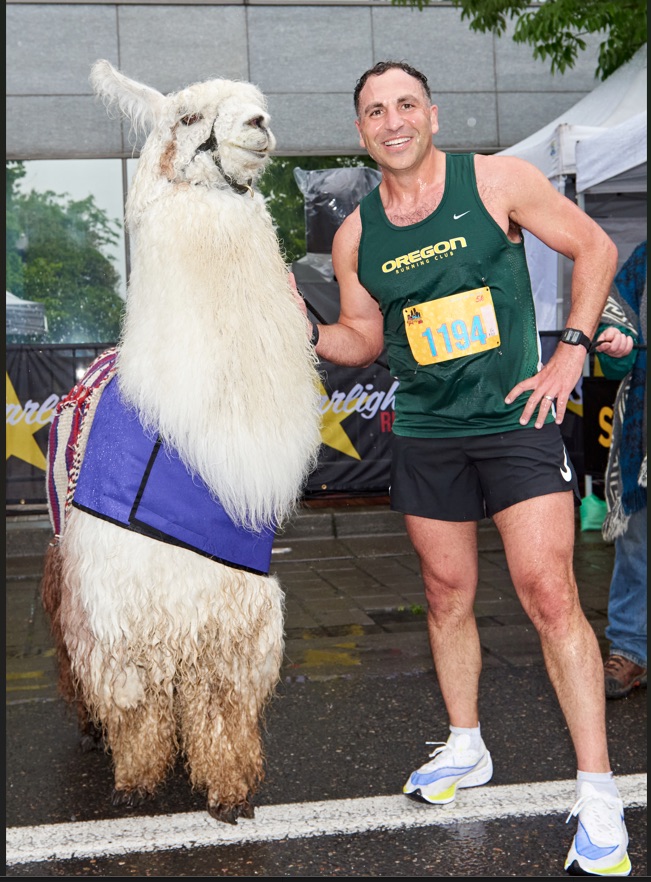
What’s happened since has been a career I couldn’t have scripted. I now serve as the university’s Faculty Athletics Representative — a role where I work directly with student-athletes, coaches, and administrators as the liaison between the academic mission and the athletic enterprise. In the classroom, I teach law students, MBA students, Executive MBA students, and undergraduates across courses in arbitration, negotiation, sports law, and sports business. Beyond campus, I’m deeply engaged with alumni and industry professionals through the Sports Conflict Institute, keynote speaking, and consulting. Internationally, I serve as an arbitrator for the Court of Arbitration for Sport, a mediator for FIFA, a salary arbitrator for Major League Baseball, an arbitrator for the U.S. Olympic and Paralympic Committee, a grievance arbitrator for U.S. Soccer, and chair of the USATF SafeSport Appeals Panel. I also sit on the NCAA Division I Committee on Infractions and the Big Ten Legislative Committee. I’ve co-authored two books published by Routledge — The Sports Playbook: Building Teams that Outperform Year After Year and Strategic Negotiation: Building Organizational Excellence — and I still compete as a masters distance runner with the University of Oregon Running Club and Bowerman Track Club, where I’ve won five national championships and three North American gold medals.
All of it lives in Oregon. And all of it connects back to that moment as a young athlete when nobody was there to help. I built the infrastructure I wish had existed.
I’m sure it wasn’t obstacle-free, but would you say the journey has been fairly smooth so far?
Not even close. And I’d be skeptical of anyone who says otherwise. No meaningful career is smooth — and the ones built at the intersection of multiple fields are especially uneven, because you’re often building the road while you’re driving on it.
The first challenge was structural. When I moved across the country to Oregon to focus on conflict resolution in sports, there was no established market for that work. People understood sports law. They understood mediation. But the idea that sports organizations needed systematic conflict management — not just lawyers after something went wrong, but proactive frameworks to prevent destructive conflict and build high-performing cultures — that was a hard sell. I was essentially building a field and a business simultaneously, and there were long stretches where the vision was clearer than the demand. The Sports Conflict Institute didn’t grow because there was a line of clients waiting. It grew because I kept demonstrating the value through results until the market caught up to the idea.
The second ongoing challenge is being a practitioner-academic hybrid. I live in two worlds that don’t always speak the same language. In academia, credibility comes from research, publication, and theoretical frameworks. In practice, it comes from being in the room, making the call, and delivering outcomes under pressure. I’ve spent my career bridging those worlds — teaching what I practice and practicing what I teach — but that positioning doesn’t fit neatly into conventional categories. It took time for both worlds to see the value in someone who refused to choose one over the other.
The challenge I’m navigating right now is probably the most complex of my career. College athletics is undergoing what I’d describe as a hundred years’ worth of change compressed into the last five. NIL transformed the economic landscape. The House v. NCAA settlement introduced revenue sharing with student-athletes. Conference realignment — including Oregon’s move from the Pac-12 to the Big Ten — restructured competitive and financial relationships overnight. The transfer portal has fundamentally changed roster management and athlete retention. And all of this is happening while institutions are still trying to figure out the rules. As Faculty Athletics Representative, I’m in the middle of that transformation every day — working with student-athletes, administrators, coaches, and governance bodies to navigate a landscape where the ground hasn’t stopped shifting. It requires a tolerance for ambiguity that most people find deeply uncomfortable, and it demands that you make thoughtful decisions with incomplete information while the stakes for the people involved — especially student-athletes — are very real.
None of that has been smooth. But smooth was never the goal. The goal was to do work that matters in spaces where it’s needed most, and those spaces are inherently messy. The struggle is part of the value proposition — if this were easy, it wouldn’t require the expertise it does.
Appreciate you sharing that. What else should we know about what you do?
I specialize in conflict resolution, negotiation, and dispute resolution in sports — from college athletics to global governing bodies. Through the Sports Conflict Institute, which I founded, I work with sports organizations at every level on building the systems, cultures, and leadership capacity to manage conflict proactively rather than reactively. Most organizations call a lawyer after the crisis. I try to build the framework that prevents the crisis — or at least ensures the organization is prepared to handle it well when it arrives.
As an arbitrator and mediator, I serve on panels for the Court of Arbitration for Sport, FIFA, Major League Baseball, the U.S. Olympic and Paralympic Committee, and U.S. Soccer, among others. That work takes me into some of the most consequential disputes in professional and international sports. I’ve co-authored two books — The Sports Playbook: Building Teams that Outperform, Year after Year with Gary Furlong and Ken Pendleton, and Strategic Negotiation: Building Organizational Excellence with Gary Furlong — both aimed at translating what works in high-stakes dispute resolution into practical frameworks anyone can use.
What sets me apart is that I do the work and teach the work — simultaneously and at the highest levels of both. At the University of Oregon, I’m a Professor of Practice in the Lundquist College of Business and teach Arbitration at the School of Law, while also serving as the Faculty Athletics Representative. That means I’m in a hearing room deciding a salary arbitration case or mediating an international federation dispute, and then I’m in a classroom the following week teaching students how those processes actually work — not from a textbook, but from the chair. Very few people occupy both of those spaces at once, and I think that combination produces something neither world can generate on its own. The practice makes the teaching real. The teaching forces me to examine and articulate why the practice works.
What I’m most proud of is the students. That’s not a rehearsed answer — it’s the truth. The international arbitration work is extraordinary. The books are lasting contributions I’m proud of. But what I keep coming back to is the students and young professionals I’ve had the chance to teach and mentor at the University of Oregon. When a former student calls to talk through a negotiation they’re facing, or when I see someone I taught working in a front office or a league office and applying frameworks we covered in class, that’s the return on investment that matters most to me. The cases end. The students carry the work forward.
Where do you see things going in the next 5-10 years?
The short version: every major trend in sports is making negotiation and conflict resolution capabilities more essential, not less. And I think the industry is starting to understand that.
Start with college athletics. Revenue sharing, potential employment models, and what could eventually become collective bargaining are arriving on campuses that have never dealt with labor relations at this scale. Athletic directors, compliance officers, and university administrators are about to navigate economic relationships and stakeholder dynamics that look much more like professional sports than anything they were trained for. The organizations that invest in building negotiation capability now — not just hiring outside counsel when something goes wrong, but developing internal capacity to manage complex multi-party relationships — will be the ones that thrive through this transition. The ones that don’t will spend the next decade in reactive mode, and it will cost them in talent, resources, and reputation.
At the professional and international level, the globalization of sports disputes is accelerating. Cross-border governance, multi-jurisdictional regulatory frameworks, and the expanding reach of bodies like FIFA and the Court of Arbitration for Sport mean that the disputes are becoming more complex, the stakes are higher, and the need for skilled neutrals and sophisticated dispute resolution systems is growing. This isn’t a trend that reverses. As sports becomes more global and more commercialized, the infrastructure to resolve the conflicts that inevitably follow has to grow with it.
Underneath all of this is athlete empowerment. Athletes at every level — from college to the Olympic movement to professional leagues — have more economic power, more voice, and more agency than at any point in sports history. That is a fundamentally good development. But it also means that the old model of top-down governance where decisions were made for athletes rather than with them is no longer viable. Organizations need systems that engage athletes as stakeholders, not just participants. That requires real negotiation skill, not just good intentions.
Where I’m most optimistic is in organizational culture as a competitive advantage. The smartest teams and organizations I work with are starting to treat conflict capability the way they treat strength and conditioning — as a foundational investment in performance, not something you address only when someone gets hurt. Building a culture where people know how to surface disagreement, negotiate competing interests, and resolve disputes constructively isn’t a soft skill. It’s a strategic advantage. And I believe the next decade will make that unmistakably clear.
This is exactly the wave the Sports Conflict Institute was built for. The need has never been greater, the awareness is growing, and the opportunity to help organizations get ahead of it — rather than just respond to it — is enormous.
Contact Info:
- Website: https://sportsconflict.org/
- LinkedIn: https://www.linkedin.com/in/joshuagordon/
- Youtube: https://www.youtube.com/@sportsconflict