



Today we’d like to introduce you to Megan Martin.
Hi Megan, we’d love for you to start by introducing yourself.
Furnish Hope began with a simple belief: everyone needs hope and a place to call home.
But the story began before there was a nonprofit, a warehouse, a storefront, a staff or even a name.
In late 2018, Furnish Hope founder Megan Martin was walking through one of the most difficult seasons of her own life. After a 20-year career in education, including serving as a school principal, her life had taken an unexpected turn. She had lost her job, her family had left their home, and much of what had once provided security and identity had suddenly changed.
Then came a message.
Megan’s church shared the need of a mother leaving Bethlehem Inn with her three children. The family had secured an apartment and was starting over—but they needed everything to make that empty space a home.
Something about the request resonated deeply.
Megan had three children of her own. She understood, in a very personal way, what it felt like to have life suddenly change and to wonder where you would land next. In that moment came a powerful vision: what if there were an organization whose purpose was simply to come alongside people who were working hard to rebuild their lives and help furnish their homes?
A week later, another request arrived. This time, a woman fleeing domestic violence was moving into safe housing and also needed everything.
The vision became impossible to ignore.
Megan shared the idea with her husband and their three sons, and together they decided to say yes.
Six months later, Furnish Hope furnished its first home for a family moving into a Habitat for Humanity house.
There was no major donor behind Furnish Hope in those early days. There wasn’t a warehouse full of furniture or a fleet of trucks waiting to make deliveries.
There was simply a willingness to say yes.
To generate money to purchase furnishings, the founders created a home-staging business and approached local real estate agents. Within the first six months, they had staged more than 20 homes while furnishing eight Habitat for Humanity homes.
But the needs in the community quickly grew beyond the resources available.
At times, the founder personally purchased furniture and maxed out credit cards trying to keep the mission moving. Then, one by one, members of the community began stepping forward.
Someone offered warehouse space.
A friend loaned a utility truck.
Friends helped produce a television commercial to tell the story.
A neighbor volunteered to receive donations.
And in 2019, Eagle Crest Resort provided Furnish Hope’s first large-scale furniture donation—three truckloads of furnishings.
Those moments became part of a pattern that would define Furnish Hope: when there was a need, the community found a way to help meet it.
Furnish Hope officially began operating as a nonprofit in 2019, and what had started in Megan’s living room began growing into Central Oregon’s only furniture bank serving Deschutes, Jefferson and Crook counties.
The original vision was relatively small. No one anticipated the scale of the need—or how quickly the community would embrace the mission.
Furnish Hope began building partnerships with local social-service organizations whose caseworkers were already walking alongside people transitioning out of homelessness, graduating from recovery programs, fleeing domestic violence, aging out of foster care, living with disabilities or medical challenges, rebuilding after natural disasters, arriving as refugees or beginning again after other significant hardships.
Those partnerships created a simple but powerful model.
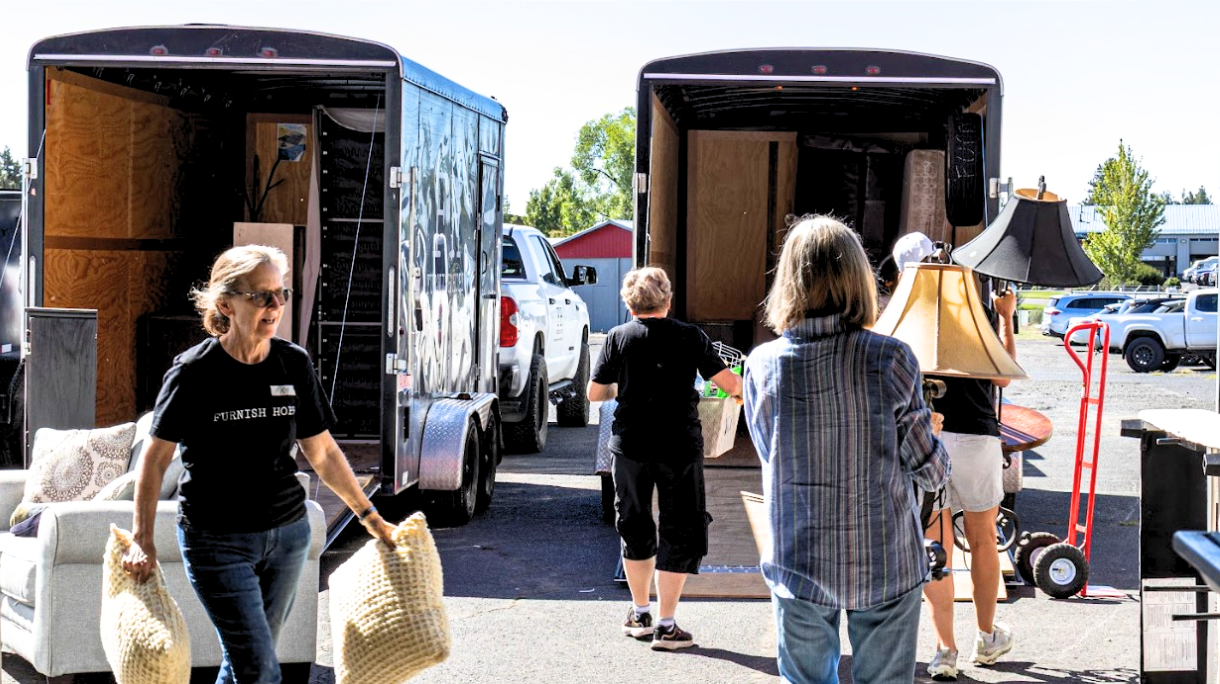
Community members donate furniture and household essentials. Volunteers receive, clean, sort, organize and prepare those items. Partner agencies connect Furnish Hope with households that need them. Then Furnish Hope brings those resources together to transform an empty house into a home—at no cost to the recipient.
By 2021, Furnish Hope was already furnishing approximately 30 homes each month with the help of more than 70 volunteers a week.
Just three years after furnishing its first home, Furnish Hope celebrated home number 1,000.
And the growth continued.
Over time, Furnish Hope discovered that its greatest resource wasn’t furniture.
It was community.
A sofa one family no longer needed became the place another family could gather together.
A donated dining table became the place children could eat dinner or do their homework.
A dresser meant someone’s clothing no longer had to be kept in bags.
A bed meant a child who had been sleeping on the floor finally had a safe and comfortable place to sleep.
And every one of those items represented a person on the other side who chose to give.
That exchange became what Furnish Hope calls its Cycle of Hope—donors, volunteers, businesses, agency partners, customers and financial supporters all playing a part in helping another neighbor begin again.
By 2023, more than 100 volunteers and more than 60 referring agencies were participating in that cycle, and Furnish Hope was furnishing more than 50 households in a typical month. By 2024, Furnish Hope furnished 532 homes and served 1,290 individuals, supported by thousands of volunteer hours and an expanding network of community partners.
Growth also required Furnish Hope to think differently about sustainability.
In September 2022, Furnish Hope opened Furnish Hope & Home, a resale storefront in Bend’s Old Iron Works district.
Beautiful donated furniture and home décor that could generate greater value through resale were directed to the store. Customers could purchase those pieces knowing their purchases directly supported Furnish Hope’s mission.
The storefront created something more than earned revenue. It opened another door into the mission.
People who might never visit the donation center or make a delivery could shop, donate, volunteer and learn the stories of the families Furnish Hope serves. The store became another part of the Cycle of Hope—turning donated furniture into resources that could furnish even more homes.
As Furnish Hope grew, so did its understanding of what it was actually providing.
Furniture is tangible. Hope is harder to measure.
But recipients consistently describe something much deeper than receiving a sofa or bed.
They talk about finally feeling safe.
They talk about being able to invite their children or friends into their home.
They talk about sitting around a table together.
They talk about dignity, stability and the feeling that someone cared enough to show up for them.
Furnish Hope began with the idea of furnishing empty houses. Over time, the mission became increasingly centered on the people who live inside them.
In 2025 alone, Furnish Hope furnished 668 homes, serving roughly 1,300 people throughout Central Oregon.
By 2026, the organization had crossed another extraordinary milestone: more than 3,000 homes furnished since its beginning.
What started with one family has become a community-wide operation furnishing approximately 50 or more homes every month.
And the need continues.
In 2026, Furnish Hope expects to furnish approximately 700 homes—more homes in a single year than at any other point in its history.
The organization is supported by a small professional staff of 8, approximately 200 active volunteers, a broad network of referring agencies and hundreds of donors, businesses and community partners who provide the furniture, funding, expertise, vehicles, labor and countless other resources that make the work possible.
The scale has changed dramatically.
The heart of the mission has not.
For years, Furnish Hope asked the community to imagine what it meant to finally have a place to call home.
Yet Furnish Hope itself had never had a permanent home.
Operations grew within approximately 5,000 square feet of warehouse space and eventually spilled into shipping containers and multiple locations. Furniture moved constantly between the donation center, storefront and homes throughout Central Oregon. Space increasingly limited the amount of furniture Furnish Hope could accept and ultimately the number of families it could serve.
The organization had reached a turning point.
In January 2026, seven years after the first home was furnished, Furnish Hope purchased a permanent home at 355 NE 2nd Street in Bend.
The nearly 22,000-square-foot, roughly 100-year-old building represents far more than additional warehouse space.
It represents the next evolution of the mission.
For the first time, Furnish Hope is designing a space around the experience of the people it serves.
Rather than simply receiving furniture selected for them, recipients will increasingly enter the building as guests. They will be welcomed into a warm environment and given opportunities to participate in choosing the furnishings that will become part of their homes.
Children will have a space designed especially for them. Families will experience hospitality rather than a transaction. Volunteers will have room to work together. Furniture donations can be processed more efficiently. Community partners will have opportunities to connect with the people Furnish Hope serves.
The building will allow Furnish Hope to bring much of its work together under one roof while creating capacity for the mission to continue growing.
The new property is also a project in transformation.
The century-old building requires substantial renovation and investment. Furnish Hope is now undertaking its largest capital campaign to date to restore the property and prepare it for decades of service.
There is something fitting about restoring an old building for this particular mission.
Every day, Furnish Hope meets people whose lives have not gone according to plan.
They have experienced homelessness, addiction, domestic violence, illness, displacement, financial hardship or other circumstances that forced them to begin again.
Their stories remind us that something can experience hardship without losing its value.
The same is true of this building.
A century-old structure is being restored and given new purpose so that, inside its walls, thousands more people can experience the dignity of a new beginning.
And even while Furnish Hope prepares its own permanent home, the work of furnishing other people’s homes has never stopped. In fact, the organization is on track to serve more households in 2026 than ever before.
The Furnish Hope of today looks very different from the vision that began in a living room in 2018.
There are thousands of furnished homes behind us.
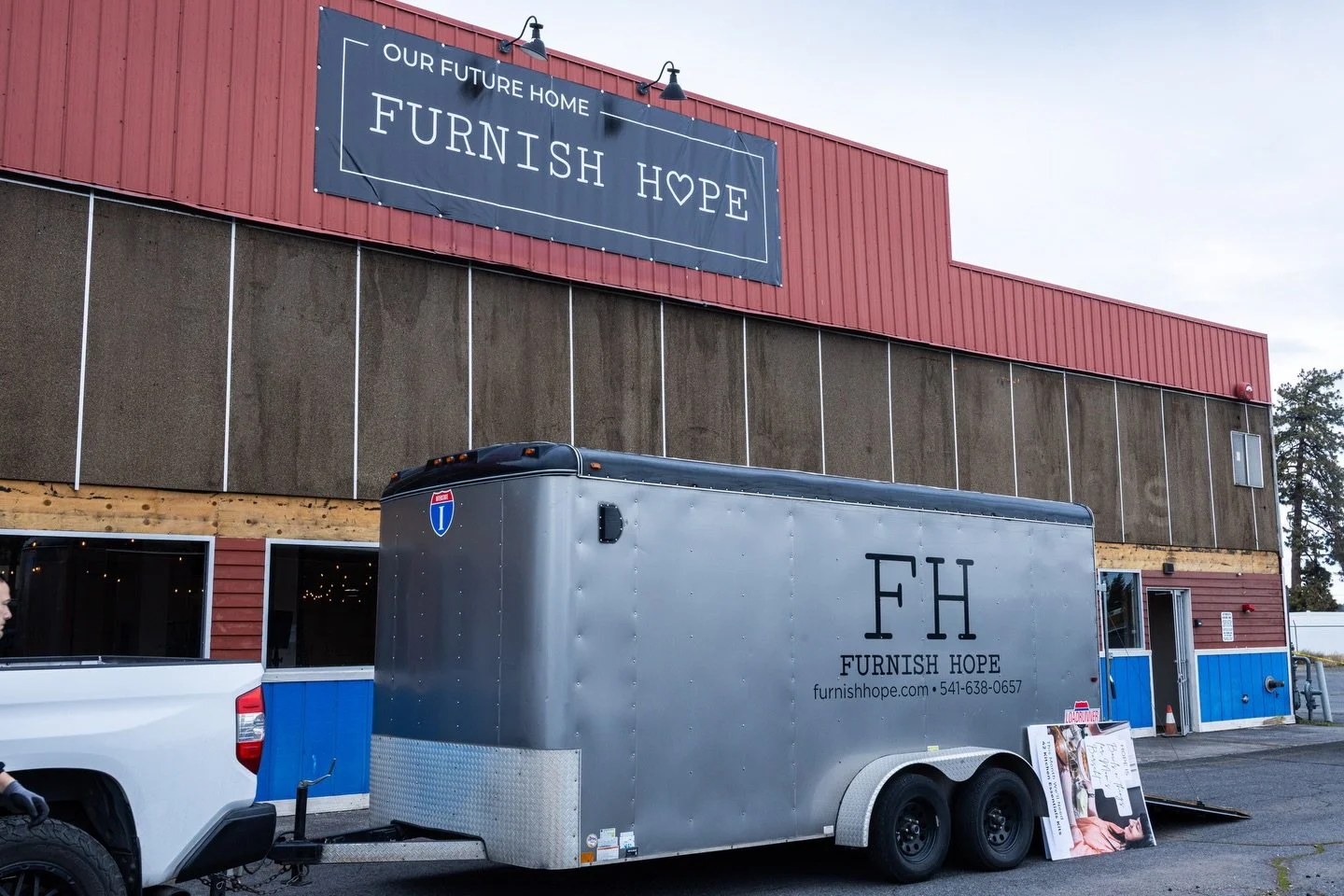
There are trucks and trailers on the road.
There is a storefront generating revenue for the mission.
There are hundreds of volunteers.
There are businesses donating products and professional services.
There are scores of community organizations connecting their clients with Furnish Hope.
There is a permanent building being restored for the future.
And there are thousands of people who have experienced what happens when a community decides that no one rebuilding their life should have to do it alone.
But underneath all of that growth is essentially the same decision that started Furnish Hope:
Someone has a need. We have something we can give. So we say yes.
Furnish Hope’s story has never really been about furniture.
It is about what happens when people choose to see one another, come alongside one another and believe that someone’s circumstances should never determine their worth.
It is about dignity.
It is about belonging.
It is about second chances and new beginnings.
And it is about a community discovering that everyone has something to give.
What began as a vision to furnish a handful of homes has become a movement of people furnishing hope throughout Central Oregon—one home, one family and one act of generosity at a time.
We all face challenges, but looking back would you describe it as a relatively smooth road?
There have been plenty of challenges along the way. In many ways, Furnish Hope’s story has been a constant balancing act: we need furniture donations, but we need space to store them. We need volunteers to prepare them, but we also need trucks, trailers, and people to get them into homes. And as soon as one part of the mission grows, it puts pressure on every other part.
There have been seasons when furniture came in faster than we had room to store it—and then someone stepped forward and donated shipping containers. There have been times when we had plenty of furniture but not enough hands to process it—and more volunteers began showing up. As the mission grew, so did the need to raise more money simply to keep pace with the number of families waiting for help. Again and again, people have stepped forward at just the right time with extraordinary generosity.
Some of those moments have felt like nothing short of answers to prayer.
We saw that in 2025 when we began pursuing a permanent home for Furnish Hope. We knew what we could responsibly afford, and we were committed to making an offer significantly below the asking price. The gap felt enormous. Yet within just four weeks, a small group of champions came alongside us and helped raise the funds needed to make the purchase possible. Then another extraordinary gift followed: a donor offered to complete the tenant improvements—by far the largest in-kind donation Furnish Hope had ever received.
But these moments of provision have been part of our story from the very beginning.
In our earliest days, we were purchasing nearly everything we gave away. At one point, we had reached the limit on our credit card and simply didn’t have the resources to keep buying furniture. We were already committed to furnishing dozens more Habitat for Humanity homes when we were asked to furnish a halfway house for men moving into sober living.
There was every practical reason to say no. Instead, we said yes.
That yes led to a connection with College HUNKS and a resort that happened to be clearing furniture from 80 rooms. Suddenly, what had seemed impossible became possible. We had enough furniture for the halfway house and the Habitat homes, and the experience opened doors for Furnish Hope to begin building relationships with many more organizations throughout the region.
Another winter, we reached a point when our warehouse was nearly empty. Ten families were scheduled to have their homes furnished the following week, and we didn’t have enough furniture to serve them. Our volunteers asked, “What are we going to do?”
I didn’t have an answer. So I got on my knees and prayed.
The next day, we received a call from the FBI. They had furniture from approximately 100 households that they wanted to donate to Furnish Hope.
I had prayed for enough furniture for ten families. What arrived was enough for one hundred.
With the support of Les Schwab, we were able to transport the furniture to Bend and store the overflow in shipping containers. That donation sustained Furnish Hope through the winter months, when furniture donations traditionally slow down.
And sometimes these lessons came through something as simple as a microwave.
Just before Christmas, we were serving a mom who had fled domestic violence with her two young children. She needed a microwave or pots and pans so she could cook for her family, and we had neither available to give her.
At home, we had a new microwave that we hadn’t even installed yet. We didn’t have extra money to replace it, and we had no idea when another one would come along. But we had pots and pans at home. She didn’t.
So we gave her our microwave.
After Christmas, I unexpectedly stopped by the warehouse. Sitting on the counter were about a dozen microwaves someone had donated to Furnish Hope.
Moments like these have shaped who we are.
The challenges have been real. There have been times when we didn’t have enough furniture, enough space, enough volunteers, enough transportation, or enough money. There have been moments when the need in front of us was far greater than the resources we could see.
But over and over again, we’ve learned that we don’t have to see the entire path before taking the next step.
We take the step we can take. We say yes when we believe we’re being called to say yes. We trust people to come alongside us. And again and again, we have watched what felt impossible become possible—often with an abundance far greater than what we thought we needed.
That has become part of the story of Furnish Hope: taking a step of faith, saying yes to what feels impossible, and watching hope multiply.
As you know, we’re big fans of you and your work. For our readers who might not be as familiar what can you tell them about what you do?
I’m a mom of three boys, a grandma to a brand-new little one, and I’ve been married for 32 years to my high school sweetheart. My family is one of the greatest gifts of my life.
Those who know me best would probably say that faith is at the center of who I am and how I live. I walk closely with the Lord, and I’ve learned to listen for His voice, trust His leading, and follow—even when I can’t see where the path is going.
Some of the moments I’m most grateful for have come when I’ve been able to fully surrender my own plans and expectations and simply say yes to what God is asking of me. That’s where I’ve seen things happen that I could never have orchestrated on my own. I’ve had the privilege of witnessing what I can only describe as miracles, and I love being able to share those stories with others.
If there is something that sets me apart, it may be a kind of fearless faith—a willingness to step toward things that seem impossible and trust God with the outcome. I’m not as concerned as I once was with what other people might think. I know who I am, I know Whose I am, and that gives me the courage to keep stepping forward.
For me, it really comes back to surrender: listening, trusting, taking the next step, and then getting a front-row seat to see what God does with it.
So, before we go, how can our readers or others connect or collaborate with you? How can they support you?
At Furnish Hope, we believe there is hope for everyone—and that hope has the power to transform a life.
Without hope, it is hard to imagine that tomorrow can be different. But when hope begins to take root, everything changes. People begin to see possibility again. They begin to believe in a future that can be better than their past.
That is what Furnish Hope has always been about.
And right now, we need a community to rally around this mission in a bigger way than ever before.
In 2026, we are working toward two significant goals at the same time: furnishing nearly 700 homes—more than ever before—while raising $2 million to complete the work on our new permanent home and move into it debt free.
It is the largest fundraising season in our history, and at times, the challenge in front of us feels almost impossible.
But we have seen again and again what can happen when a community comes together around something that matters.
Every gift matters. A $10 gift matters. A $100 gift matters. A $10,000 gift matters. Every act of generosity moves us one step closer to opening these doors and continuing to bring hope into homes throughout our community.
And financial gifts are only one way to help.
Our nearly 100-year-old, 22,000-square-foot building needs significant improvements, including a new roof, insulation, HVAC systems, and other major infrastructure work. We are looking for businesses, contractors, suppliers, and community partners who may be willing to come alongside us through donated materials, in-kind services, expertise, or financial support.
This invitation extends beyond Central Oregon. We hope people from communities near and far will see themselves as part of this story.
Because our dream is bigger than one building.
One day, we hope to see Furnish Hope replicated in other communities—helping more families experience dignity, belonging, and the hope that comes with having a place that truly feels like home.
But to get to that someday, we need help with where we are today.
We need people who believe, as we do, that hope changes lives.
And together, we believe we can do what right now may seem impossible.
Contact Info:
- Website: https://www.furnishhope.com/
- Instagram: https://www.instagram.com/furnishhope/
- Facebook: https://www.facebook.com/furnishhopeoregon/